Supreme Court Appointments: Judge Bork and the Politicization of Senate Confirmations by Norman Vieira & Leonard Gross
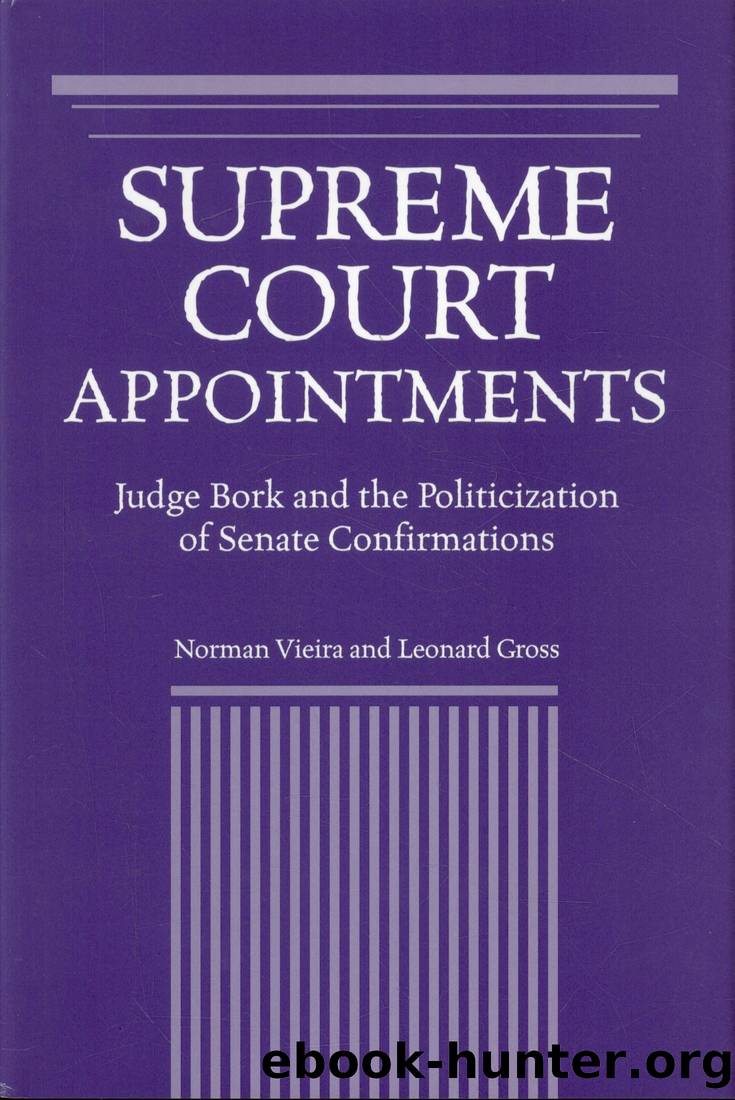
Author:Norman Vieira & Leonard Gross [Vieira, Norman & Gross, Leonard]
Language: eng
Format: epub
Tags: Law, Courts, Political Science, Constitutions, test
ISBN: 9780809322046
Google: g5eoFhCmFIEC
Amazon: 0809322048
Publisher: SIU Press
Published: 1998-10-15T05:00:00+00:00
14 The Media Campaign: Polling and Advertising in the Confirmation Process
Public opinion polls and media advertising played an unprecedented role in the battle to defeat the Bork nomination. Polling results signaled that Bork was beatable and thereby encouraged potential opponents to exert greater efforts to defeat the nomination. Bork's opponents were also able to use polls to learn which issues would be most effective in their advertising campaign. Finally, polls were used at the end of the process to convince senators that it was politically wise to vote against Bork's confirmation. Early polls showed that despite widespread publicity, most people had never heard of Robert Bork. Among those who had heard of him, public opinion was closely divided. In a Washington Post-ABC News poll conducted in August, 45 percent of this group approved the nomination and 40 percent disapproved.1 However, a majority of all of those interviewed in the poll said that they had not read or heard anything about Judge Bork.2 The early polls also suggested that it would be politically feasible for the Senate to expand on its traditional role in Supreme Court confirmations. In the Washington Post-ABC News poll of August 35, 46 percent said the Senate should consider only Bork's background and qualifications in deciding whether to confirm him, but 51 percent said the Senate should also consider Bork's legal views.3 And in the Martilla & Kiley poll conducted for AFSCME, a labor union representing state and municipal employees, a large majority expressed the view that the Senate would be justified in rejecting a nominee who was "committed to a narrow philosophy" or who "does not seem to be a fair-minded person."4 By framing the question in this way, the pollsters clearly suggested that Judge Bork was committed to a narrow philosophy and was not fair minded. This made it more likely that interviewees would favor Senate consideration of Bork's judicial philosophy. If the public could be persuaded that Bork's legal philosophy was wrong headed, voter sentiment would then be used to generate pressure on members of the Senate. The polling data clearly showed Bork's vulnerability with important segments of the Democratic Party, which was still in control of the U.S. Senate. The Martilla & Kiley poll showed that Bork was generally supported by a majority of whites, males, and Republicans but that he was opposed by most blacks, women, and Democrats.5 Opponents of the Bork nomination were able to exploit this information because a number of southern senators had been elected with only a minority of white votes and an overwhelming majority of black votes. By demonizing Bork among black voters, opponents could bring enormous pressure to bear on these senators. The key was to find issues with which to persuade voters that Bork's judicial philosophy would be harmful to them. The Martilla & Kiley poll showed that voters could be persuaded to oppose the Bork nomination if they became convinced that Bork was not "fair minded" and that the best way to increase voter skepticism would be to show that Bork was unsympathetic to civil rights.
Download
This site does not store any files on its server. We only index and link to content provided by other sites. Please contact the content providers to delete copyright contents if any and email us, we'll remove relevant links or contents immediately.
| Anthropology | Archaeology |
| Philosophy | Politics & Government |
| Social Sciences | Sociology |
| Women's Studies |
The Secret History by Donna Tartt(19466)
The Social Justice Warrior Handbook by Lisa De Pasquale(12292)
Thirteen Reasons Why by Jay Asher(9115)
This Is How You Lose Her by Junot Diaz(7054)
Weapons of Math Destruction by Cathy O'Neil(6465)
Zero to One by Peter Thiel(5947)
Beartown by Fredrik Backman(5930)
The Myth of the Strong Leader by Archie Brown(5623)
The Fire Next Time by James Baldwin(5579)
How Democracies Die by Steven Levitsky & Daniel Ziblatt(5321)
Promise Me, Dad by Joe Biden(5228)
Stone's Rules by Roger Stone(5185)
A Higher Loyalty: Truth, Lies, and Leadership by James Comey(5083)
100 Deadly Skills by Clint Emerson(5023)
Rise and Kill First by Ronen Bergman(4890)
Secrecy World by Jake Bernstein(4873)
The David Icke Guide to the Global Conspiracy (and how to end it) by David Icke(4846)
The Doomsday Machine by Daniel Ellsberg(4618)
The Farm by Tom Rob Smith(4609)
